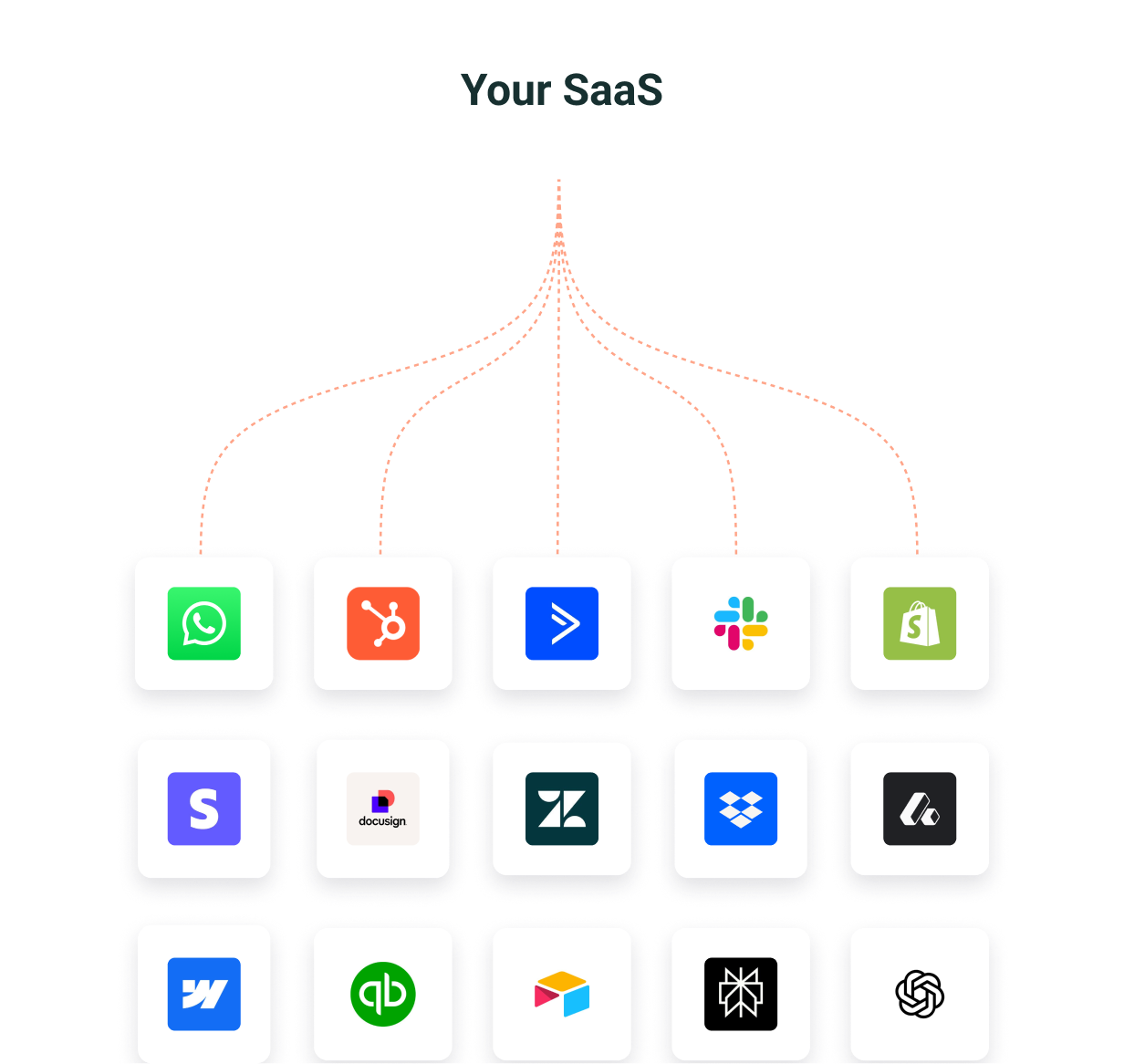





Software integration services that connect the tools you already run

Your CRM, your accounting tool and your support desk each hold a different version of the same customer, so somebody spends their week copying rows between them. We build the connections that stop that happening, on Make.com, n8n, Zapier or custom middleware, including the systems nobody else supports.

Book a free consultation
Makeitfuture software and SaaS integrations overview

Companies we've worked with

  • Moodle
  • Kinderpedia
  • Decathlon
  • MeetGeek
  • MFR

Your tools are fine. The wiring between them isn’t.

Disconnected stack

  • The CRM, the accounting tool and the support desk each hold a different customer record
  • Somebody spends hours every week copying rows between systems
  • Two reports disagree and nobody can say which number is right
  • A lead sits in an inbox overnight before the right person hears about it
  • Your niche ERP has no connector, so it stays an island
  • Every new tool you buy adds another manual handover

Connected stack

  • One source of truth for each record, agreed before anything is built
  • Data moves between systems in seconds, with no retyping
  • Finance, sales and support pull the same number from the same place
  • Leads reach the right person while they’re still warm
  • Custom connectors for the systems no platform supports out of the box
  • Failures show up in logs and alerts instead of in a customer’s inbox

What we offer

Our software and SaaS integration services

  • Connecting your existing stack

    We map what you run, decide which system owns each record, then build and monitor the flows between them. Most projects start here, and most of them pay for themselves in recovered admin time.

  • Custom connectors when none exist

    Your niche ERP, the local invoicing tool, the internal system somebody built in 2014. If it has an API we can connect it, and if it only has scheduled exports we can usually still work with that.

  • Middleware and API orchestration

    When several systems need to agree before anything is written, point to point connections stop being enough. We design the layer that sits between them, handles retries and errors, and gives you somewhere to look when something breaks overnight.

  • CRM and ERP integration

    The two systems that cause the most pain, because they hold the records everything else depends on. We connect HubSpot, Salesforce, Business Central, Odoo and the rest to the tools around them.

  • Ongoing support and monitoring

    APIs change, tokens expire, a vendor deprecates an endpoint without telling anyone. We monitor what we build and fix it under SLA, so the integration doesn’t quietly rot six months after go live.

Connect the tools you already pay for

You don’t need new software. You need the software you have to agree with itself.

  • A written map of your systems and the data each one owns
  • Source of truth agreed per record before a single flow is built
  • Monitoring on every flow, so a silent failure doesn’t become a month of bad data

The systems no platform supports out of the box

Most of the integrations we build involve at least one tool with no ready made connector.

  • Custom connectors built against your system’s API
  • File and database level integration where no API exists
  • An honest answer during discovery if a system genuinely can’t be reached

A middleware layer you can actually debug

Queuing, retries, error handling and an audit trail, so a failed sync doesn’t just disappear.

  • Retry and queue logic sized for your real volume, not today’s volume
  • A replayable log of every message, for compliance and for reconciliation
  • Systems stay swappable, so replacing your CRM doesn’t mean rebuilding twelve integrations

Start where the records live

Get the CRM and the ERP right and most of the downstream mess resolves itself.

  • Two way sync with clear rules about which side wins a conflict
  • Deduplication and field mapping agreed with the people who use the data
  • A parallel run against your manual process until the numbers match

Integrations decay unless somebody watches them

The failure mode is rarely a crash. It’s a flow that silently stops running and nobody notices for a fortnight.

  • Alerting on failed and skipped runs, not just on outages
  • 24/7 monitoring and support under SLA
  • Changes handled when your tools change, without a new project every time

What you get

How can software integration help you?

  • 10 to 20 hours saved per employee, every week

    That’s what clients typically stop spending on manual data entry once their core systems talk to each other. It’s also the number that makes the business case, because your finance director can check it.

  • 30 to 40% lower operating costs

    Measured on the processes we automate, against what the same work cost when it was done by hand. Most projects pay for themselves within 3 to 6 months on time savings alone.

  • Up to 90% fewer manual errors

    Copy and paste has a failure rate that nobody measures. Automated flows have logs, alerts and a replay button, so a mistake shows up before a customer finds it.

  • One version of the number

    When finance, sales and support pull the same figure from the same source, the weekly argument about whose report is right goes away.

  • Faster reaction time

    A lead that reaches the right salesperson in seconds instead of the next morning is a different lead by the time they’re called.

  • Room to add tools without chaos

    A stack with a designed integration layer can absorb the next system. A stack held together by forty point to point connections can’t.

Before you buy anything

When do you need middleware, and when don’t you?

Plenty of integration problems don’t need a middleware layer, and plenty of agencies will sell you one anyway. Here’s the honest split.

A direct connection is enough when

  • Two systems need to talk and the data flows mostly one way
  • Volume is modest and rate limits aren’t in sight
  • Both ends have a stable, documented API
  • A native connector or a single scenario already covers it

You need middleware when

  • Three or more systems need the same data and you can’t say which one owns it
  • What happens next depends on conditions across more than one system
  • A failed sync can’t just disappear, so you need retries and queuing
  • Volume is high enough that rate limits and batching matter
  • You need an audit trail, for compliance or because reconciling by hand became somebody’s job
  • Systems have to stay swappable as the business changes

How to choose middleware built for API orchestration

Start with where it has to run. If your data can’t leave your infrastructure, self hosted n8n or a custom service is the answer, and hosted iPaaS pricing stops mattering.

If it can leave, compare three things: how the tool handles a failure halfway through a multi step flow, whether you can replay what happened, and the cost at ten times your current volume.

Read our iPaaS comparison guide

We build on Make.com, n8n, Zapier and custom services, and we’ll recommend the one that fits rather than the one we’d prefer to sell.

How it runs

How a software integration project works

  1. Discovery, about a week

    We map your systems, the data each one owns, and where the manual work actually sits. You get a written scope with a fixed price, whether or not you carry on with us.

  2. Architecture, one to two weeks

    We agree the source of truth for each record, pick the platform, and design the error handling before anything gets built.

  3. Build, two to six weeks

    A simple two system sync can be live in days. A multi system flow with custom connectors takes longer, and we’ll tell you which one you have during discovery rather than after.

  4. Testing and handover

    We run the new flows in parallel with your manual process until the numbers match, then switch over.

  5. Support under SLA

    Monitoring, fixes and changes when your tools change. 24/7 monitoring and support, with fixes handled under SLA.

For software companies

Building integrations into your own product

If you sell software rather than buy it, the problem runs the other way. Your users keep asking for integrations you don’t have time to build, and every one you skip is a deal that goes quiet.

We build Make.com apps, Zapier integrations and n8n nodes for SaaS products, so your users can connect you to the 6,000+ tools those platforms already reach without you maintaining a connector for each one. That covers the app itself, the templates your users start from, and the support when their flows break.

FAQs about software and SaaS integration

  • What is software integration?

    It’s connecting separate business tools so they share data and trigger each other automatically, instead of somebody moving information between them by hand. Most companies start with two systems that disagree, and end up designing how the whole stack shares data.

  • How do I choose middleware built for API orchestration?

    Start with where it has to run. If your data can’t leave your infrastructure, self hosted n8n or a custom service is the answer and hosted iPaaS pricing doesn’t apply. If it can leave, compare how each tool handles a failure partway through a multi step flow, whether you can replay what happened, and the cost at ten times today’s volume. Most tools look similar until one of those three questions gets asked. Our iPaaS comparison guide goes through the options in more detail.

  • Who should we hire to integrate our SaaS tools?

    Someone who works across platforms rather than reselling one. An agency tied to a single iPaaS will recommend it whether or not it fits your volume, your data residency rules or your budget. Ask any shortlist what they’d do if the best answer turned out to be a tool they don’t sell.

  • How long does a software integration take?

    A two system sync using existing connectors goes live in days. A flow across several systems, with custom connectors and real error handling, usually runs two to six weeks from scope to production. We give you the timeline in writing after discovery, not before.

  • What does software integration cost?

    It depends on how many systems are involved, whether connectors already exist, and how much logic sits between them. Discovery is fixed price and gives you a scope you can take elsewhere if you’d rather. Platform costs (Make.com, n8n hosting, Zapier) are separate, and we’ll size them against your real volume rather than the headline price.

  • Can you connect a tool that has no native connector?

    Yes, and it’s most of what we do. If the system has an API we build a custom connector. If it only has scheduled exports or a database we can reach, we work with that instead. If there’s genuinely no way in, you’ll hear that during discovery rather than after you’ve paid for a build.

  • Do we have to switch platforms to work with you?

    No. If you already run Make.com, Zapier, n8n or Power Automate, we work inside it. We only raise migration when your current platform costs you significantly more than the alternative at your volume, and we’ll show you the maths before you decide.

  • Is our data safe?

    We’re ISO 27001 and ISO 9001 certified and GDPR compliant. Where data can’t leave your environment, we deploy self hosted n8n or custom services inside your own infrastructure rather than routing it through a hosted platform.

  • Is this the same as AI integration?

    No, and it helps to name the right one. Software integration connects business tools to each other, building the connections and workflows your stack needs. AI integration is a different job: connecting AI models to your existing systems so they can read your data and act inside your tools. We do both, and they are part of our wider AI services; if your goal is to put AI to work inside your stack rather than connect two apps, start with AI integration.

Ready to grow and agentify your business?

Let's find together where you can implement AI and automation securely, and built to last.

Book a strategy call
  • Addmark logo
  • Red Club logo
  • Players Poker logo
  • CleanCat logo
  • Capace cu Suflet logo