Exploring the capabilities of Introducing Bubble the powerful no code platform for creating digital products is a pivotal step for modern development.
You want business apps shipped quickly, with solid security, clean UX, and scalable data. Bubble is a no code platform that lets your team design, build, and launch production web applications without writing traditional code. This article explains what Bubble is, how it works, where it fits, and where it does not.
You will find a step by step view of Bubble’s workflow, clear reasons to choose it for your next web project, concrete examples of what you can build, and realistic limitations to consider. We close with guidance on how Makeitfuture helps organizations deliver measurable ROI with Bubble and no code, from MVP to scale.
WHAT IS BUBBLE.IO?
Bubble.io is a visual web application builder that combines UI design, a hosted database, business logic, and integrations in one platform. You create interfaces by dragging components, define data types and privacy, and orchestrate logic with workflows instead of writing code. Bubble also provides hosting, versioning, domains, and a plugin marketplace, so teams can ship complete web apps from a single place. See the Bubble Manual for an authoritative feature overview and concepts such as the editor, database, workflows, and responsive engine (Bubble Manual).
Typical outcomes include internal tools, client portals, customer facing SaaS, marketplaces, and process automation. Adoption of low code and no code is now mainstream, which matters for risk and vendor selection. Gartner projects that by 2025, 70 percent of new applications developed by enterprises will use low code or no code technologies, indicating strong ecosystem maturity.
HOW BUBBLE WORKS
Bubble streamlines the full application lifecycle, from data model to deployment, inside a unified editor. Here is how you build with it, end to end.
- Model your data. Define data types, fields, and option sets in the Data tab. Configure Privacy Rules to restrict who can read or write each record, a key step for security and compliance.
- Design responsive pages. Use the visual editor to drag elements, set constraints, and define styles. The responsive engine supports containers, alignment, and breakpoints for mobile to desktop layouts.
- Define workflows and logic. Create event driven workflows, for example, when a button is clicked, sign the user up, create a record, send an email, and navigate. Use conditions and custom events for reusable logic.
- Integrate external systems. Install plugins, or connect any REST API with the API Connector to push or pull data, handle OAuth, and call webhooks. This is how you attach payments, CRMs, ERPs, or AI services.
- Secure authentication and roles. Use built in user management, multi factor options via plugins, and role based logic with privacy rules and conditionals. Align controls with a security baseline like OWASP ASVS.
- Test in development. Bubble provides a development and live version by default. Use versioning, preview links, and logs to validate flows, performance, and edge cases before release.
- Deploy and scale. Connect your domain, promote to live, and monitor server capacity, page load, and workflow execution. Bubble handles hosting and scaling at the platform layer. Review Bubble’s security and infrastructure posture for due diligence.
- Iterate fast. Update data structure, UI, and workflows without redeploying infrastructure, which shortens feedback loops and accelerates roadmap delivery.
The critical takeaway: Bubble compresses the stack, so a small cross functional team can design, build, and release working software in weeks, then refine it continuously.
WHY CHOOSE BUBBLE FOR YOUR WEB PROJECTS?
Executives choose Bubble to ship faster, reduce engineering backlog, and validate markets with less risk. The platform is opinionated where it should be, flexible where it counts.
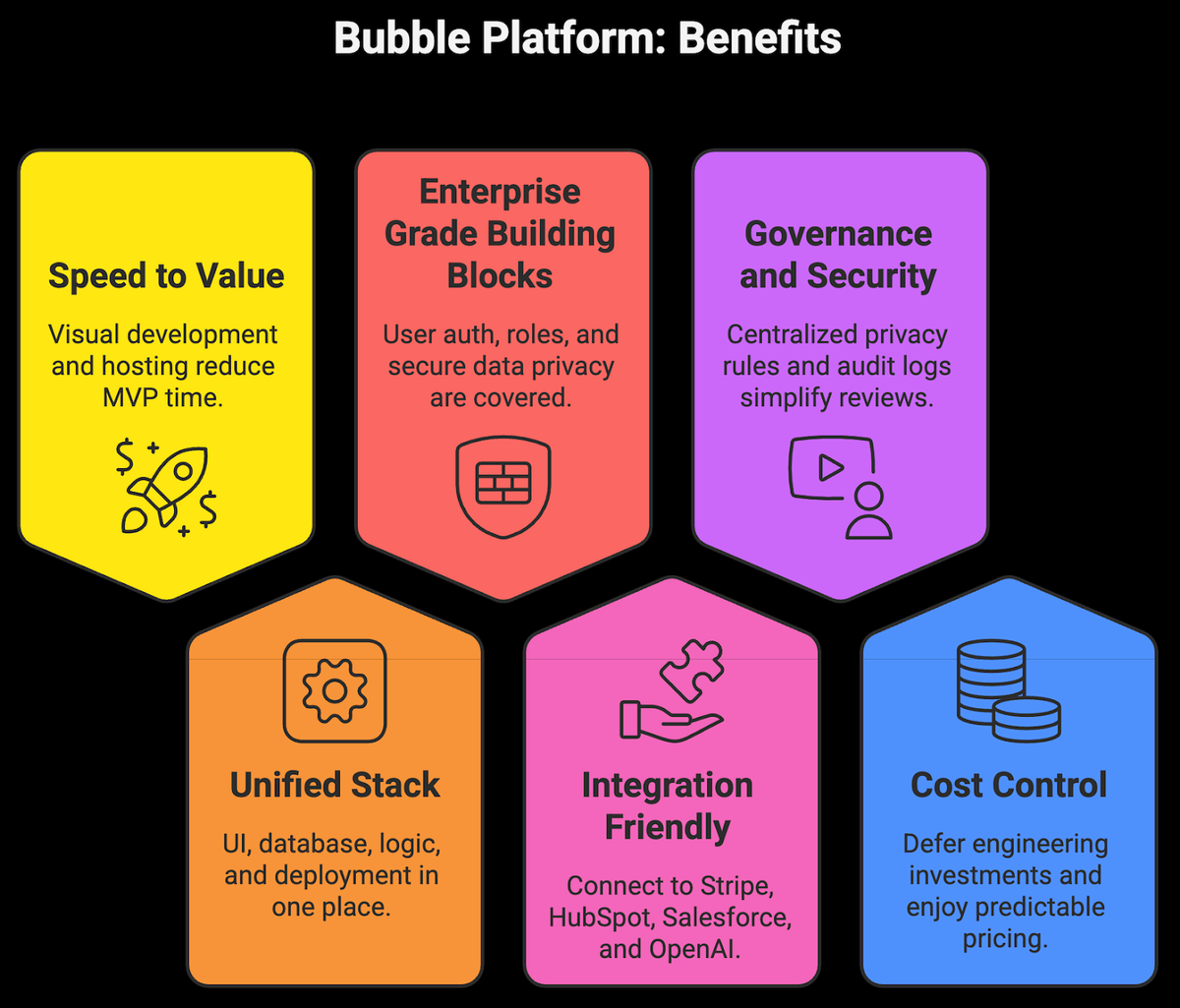
- Speed to value. Visual development and out of the box hosting cut time to MVP, which lets you test pricing, UX, and features early. Enterprise adoption of low code and no code continues to grow, signaling operational viability.
- Unified stack. UI, database, logic, and deployment in one place reduces context switching and tool cost, simplifying governance and change control.
- Enterprise grade building blocks. User auth, roles, secure data privacy, responsive UI, API integration, and plugin marketplace cover most common app needs out of the box.
- Integration friendly. Connect to Stripe for billing, HubSpot or Salesforce for CRM, OpenAI for AI features, and more through API Connector or plugins.
- Governance and security. Centralized privacy rules, audit logs, and environment separation simplify reviews. Bubble publishes security practices, helpful for legal and risk teams.
- Cost control. You can defer large engineering investments until you have traction. Platform pricing is predictable, and maintenance overhead is lower than custom stacks for many internal and mid scale customer apps.
Where Bubble fits compared to alternatives: Build path Time to MVP Upfront cost Flexibility Maintenance burden Bubble (no code) Weeks Low High for business apps Low to moderate Traditional custom code Months High Very high High Other low code platforms Weeks Moderate Varies by vendor Moderate
EXAMPLES OF WHAT YOU CAN MAKE WITH BUBBLE NO-CODE
Teams ship a wide range of production apps on Bubble. A few patterns we see repeatedly deliver value fast.
- Client portals that aggregate account data from your CRM and ERP, with secure role based access, file sharing, and messaging.
- Subscription SaaS, for example, KPI dashboards, quoting tools, or analytics portals with Stripe billing and tiered features.
- Two sided marketplaces with listings, search and filters, secure payments and escrow, and messaging.
- Internal tools and workflow automation, such as approvals, inventory, field operations, or vendor onboarding, integrated via REST to systems of record.
- AI enhanced apps, for example, document summarization, assisted data entry, or customer support copilots that call the OpenAI API through Bubble’s API connector.
- Data collection and forms at scale, with validation, branching logic, and analytics.
- Progressive web app style mobile experiences, wrapped as needed to enable push notifications and app store presence.
If your app is CRUD heavy, workflow centric, and integration driven, Bubble is usually a strong fit.
LIMITATIONS OF BUBBLE
No platform fits every use case. Plan for these constraints before you commit.
- Export and lock in. You cannot export the app as source code, so long term portability requires planning. Architect critical logic and data models for interoperability via APIs.
- Performance for extreme scale. Very high concurrency, complex algorithms, or heavy real time computation may push the platform beyond comfort. Offload compute heavy workloads to dedicated services, then integrate via APIs.
- Mobile native features. Bubble targets the web. Native mobile capabilities like offline first, background tasks, and push notifications require wrappers or external services.
- Granular version control. Team collaboration and branching are supported but are not a replacement for Git based workflows used in large engineering groups. Define clear release governance.
- Advanced custom UI. Pixel perfect, highly animated experiences may require custom code components or careful performance tuning.
- Compliance scope. Review Bubble’s security posture, data residency, and certifications against your regulatory needs. Use privacy rules rigorously and align to standards like OWASP ASVS.
- Plugin dependencies. Relying on third party plugins adds vendor risk. Prefer the API connector or first party integrations for critical paths.
- Accessibility. Achieving WCAG compliance is possible but requires deliberate design and testing.
These are manageable with the right architecture, governance, and a clear definition of nonfunctional requirements.
HOW CAN MAKEITFUTURE HELP YOU WITH NO-CODE DEVELOPMENT SOLUTIONS?
Conclusion. Bubble is a powerful no code platform for building production web applications fast. It consolidates the toolchain, integrates cleanly with your stack, and lowers the cost to learn, prototype, and iterate. It is not a fit for every edge case, especially algorithm heavy or extreme real time workloads, but combined with targeted microservices it covers most business application needs with excellent speed to value.
Makeitfuture helps leadership teams turn Bubble into measurable ROI. We design the right product scope, implement secure data models and privacy, integrate core systems, and set up a governance model that your IT and risk teams endorse. Then we train your operators to own and extend the app safely.
- Discovery and roadmap, align business goals to a lean MVP and measurable success metrics.
- Architecture and security, data modeling, privacy rules, SSO, and alignment to OWASP ASVS.
- Build and integration, responsive UX, workflows, and connections to ERP, CRM, billing, and AI services.
- Pilot to scale, performance tuning, monitoring, change management, and Center of Excellence enablement.
- Capability transfer, training your team to ship enhancements without creating shadow IT.
Explore our no code services and see how we can accelerate your roadmap.
Ready to de-risk your MVP and move faster with Bubble? Talk to us about a two week pilot that delivers a clickable prototype, a technical blueprint, and a clear build plan.