Discover how Business Process Management Software can transform your company's efficiency and workflow optimization.
You want measurable gains in speed, cost, and quality. This article explains what is business process management, how BPM software, often called BPMS, works, and where it fits with intelligent automation. You will find practical selection criteria, a short list of processes worth tackling first, and a simple path to pilot and scale.
By the end, you will know how to use BPM to orchestrate people, systems, and AI so you can standardize execution, cut cycle time, and prove ROI.
WHAT IS BUSINESS PROCESS MANAGEMENT (BPM)?
Business Process Management is the discipline of designing, executing, monitoring, and improving the end to end activities that deliver business outcomes. It blends methods, governance, and technology to make work observable, repeatable, and optimizable. BPM is a management practice first, then a tooling choice. A widely used reference for the discipline is the ABPMP Common Body of Knowledge, which frames BPM as a continuous improvement cycle across the enterprise.
- Discover, map, and measure current processes using interviews, system logs, and process mining.
- Design target processes with clear roles, rules, and KPIs, often modeled in BPMN.
- Automate and orchestrate tasks across people, apps, and robots.
- Monitor execution in real time with dashboards and alerts.
- Optimize based on data, adjust rules and paths, and institutionalize improvements.
For definitions and standards, see ABPMP’s BPM CBOK, which codifies the discipline, and BPMN 2.0 from the Object Management Group, the de facto notation for process modeling (ABPMP CBOK overview: https://www.abpmp.org/page/CBOK, BPMN 2.0 specification: https://www.omg.org/spec/BPMN/2.0.2/).
WHY IS BPM IMPORTANT FOR YOUR BUSINESS
If you are scaling, integrating acquisitions, or introducing AI, unmanaged processes create waste and risk. BPM gives you a system of record for how work actually flows, then lets you change it with control.
- Cost and cycle time reduction. Standardized flows remove rework and delays, a prerequisite to automation at scale. McKinsey estimates that with modern AI, 60 to 70 percent of worker activities could be automated or augmented, but only when processes are well defined (McKinsey, The economic potential of generative AI, 2023: https://www.mckinsey.com/capabilities/quantumblack/our-insights/the-economic-potential-of-generative-ai-the-next-productivity-frontier).
- Consistent customer experience. Defined paths and SLAs reduce variance in response times and outcomes.
- Compliance and auditability. Logged steps, approvals, and rules provide evidence for standards like ISO 9001 and regulated processes such as SOX 404 (ISO 9001:2015 process approach: https://www.iso.org/standard/62085.html).
- Data driven decisions. KPIs, throughput, and bottleneck analysis drive continuous improvement rather than opinion wars.
- Change agility. Central models and rules allow you to ship process changes fast without brittle one off scripts.
WHAT IS A BUSINESS PROCESS MANAGEMENT SOFTWARE?
A Business Process Management Software, often called a BPMS or intelligent BPM suite, is a platform to model processes, build forms and user tasks, encode business rules, integrate systems, automate steps with RPA or APIs, and monitor performance. It provides a process engine to execute paths, a rules engine for decisions, a workflow UI for humans, and analytics for control.
Related categories overlap. Use the right tool for the right job, or combine them under one governance model.
Category Best for Strengths Representative tools Intelligent BPMS End to end processes with human tasks and complex rules Model driven, strong orchestration, case management Appian, Pega, IBM Business Automation Workflow, Camunda Low code workflow Departmental flows and rapid automation Fast delivery, native connectors, business friendly Microsoft Power Automate, ServiceNow Flow Designer, Salesforce Flow RPA UI level automation for legacy apps without APIs Non invasive, quick wins, task automation UiPath, Automation Anywhere, SS&C Blue Prism Process mining Discovering as is flows and bottlenecks from logs Ground truth from system data, opportunity sizing Celonis, UiPath Process Mining, Microsoft Process Advisor Integration and orchestration API first system to system flows and events Scale, reliability, developer control MuleSoft, Boomi, Workato
Process mining is frequently used with BPM to identify improvement areas and measure impact. The IEEE Task Force describes process mining as extracting insights from event logs to discover, monitor, and improve processes, a powerful companion to BPM initiatives (IEEE Process Mining Manifesto: https://ieeexplore.ieee.org/document/6398346).
BENEFITS OF USING A BPM SOFTWARE
A BPMS makes process change programmable and observable. You get a digital twin of operations and the controls to keep outcomes reliable as you scale.
- End to end visibility. Live dashboards and audit trails expose throughput, wait times, and failure points.
- Standardization and governance. Centralized models, roles, and rules reduce variance and support ISO style process control (ISO 9001:2015: https://www.iso.org/standard/62085.html).
- Faster delivery. Low code designers and reusable components cut time to release new flows.
- Lower operating cost. Automation of routine steps reduces manual effort. A Forrester TEI study found a 199 percent ROI over three years for organizations adopting Microsoft Power Automate, driven by labor savings and error reduction (Forrester TEI of Microsoft Power Automate, 2022: https://www.microsoft.com/en-us/power-platform/blog/2022/04/05/forrester-study-total-economic-impact-of-power-automate/).
- Better compliance. Embedded approvals, segregation of duties, and evidence trails simplify audits.
- AI readiness. Clear processes let you safely embed AI for classification, summarization, and recommendations where it actually creates value.
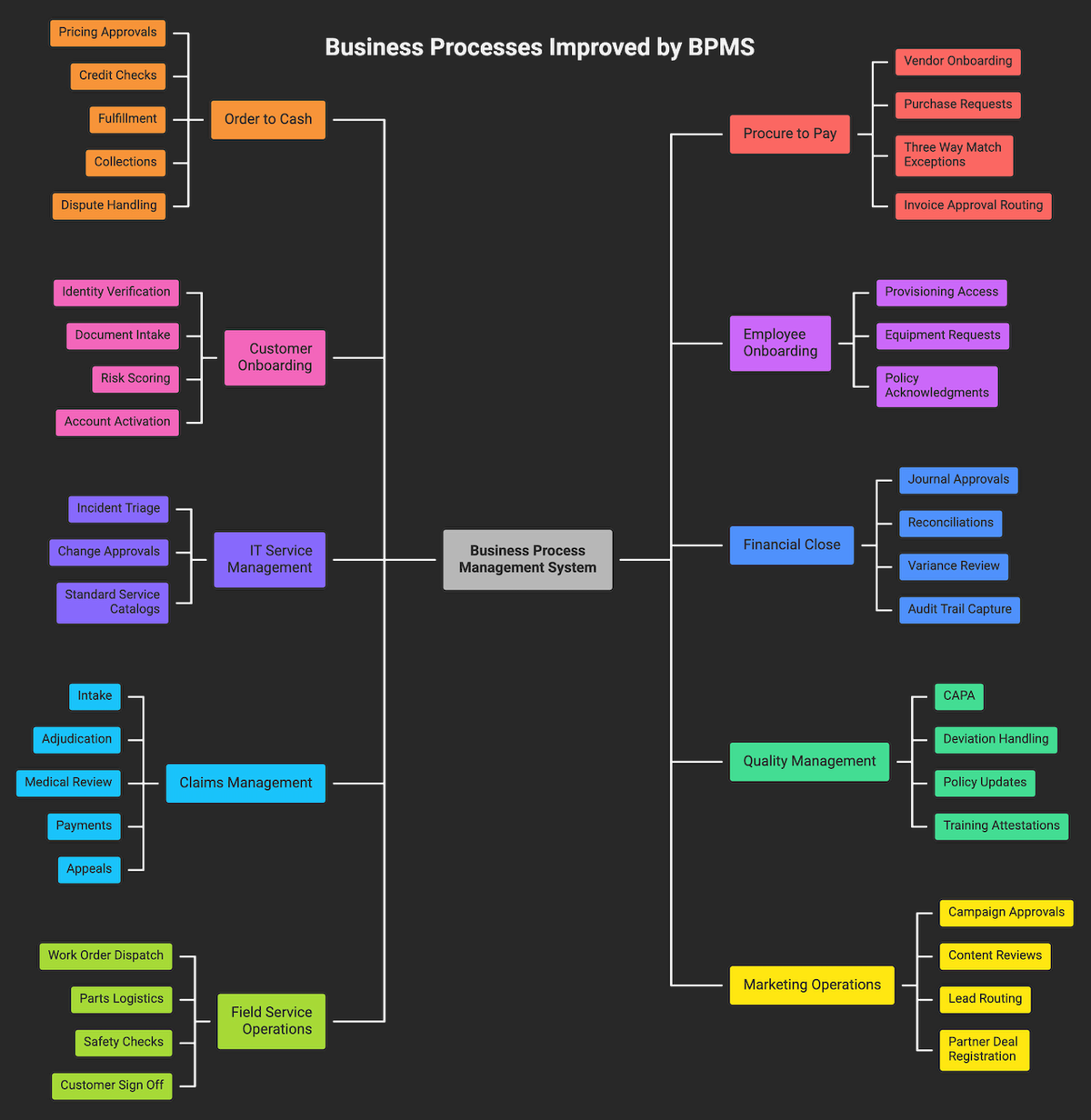
WHAT BUSINESS PROCESSES CAN BE IMPROVED USING A BPMS?
Start where volume, variability, and risk are high. These processes routinely deliver strong returns when managed and automated with a BPMS.
- Order to cash, quote to cash. Pricing approvals, credit checks, fulfillment, collections, dispute handling.
- Procure to pay. Vendor onboarding, purchase requests, three way match exceptions, invoice approval routing.
- Customer onboarding and KYC. Identity verification, document intake, risk scoring, account activation.
- Employee onboarding and offboarding. Provisioning access, equipment requests, policy acknowledgments.
- IT service management and request workflows. Incident triage, change approvals, standard service catalogs.
- Financial close and controls. Journal approvals, reconciliations, variance review, audit trail capture.
- Claims and case management. Intake, adjudication, medical review, payments, appeals.
- Quality and compliance management. CAPA, deviation handling, policy updates, training attestations.
- Field service operations. Work order dispatch, parts logistics, safety checks, customer sign off.
- Marketing and sales operations. Campaign approvals, content reviews, lead routing, partner deal registration.
WHAT KEY FEATURES SHOULD YOU CONSIDER WHEN SELECTING BPM SOFTWARE?
Prioritize features that align to your complexity, integration landscape, compliance needs, and talent model. Buy for the next three years, not just the first use case.
- Process modeling and standards. Native BPMN 2.0 for clarity and portability, and DMN for decision logic when you need explicit rules.
- Process and task mining. Built in or integrable mining to discover flows, quantify waste, and track before and after improvements.
- Human workflow and UX. Forms, mobile, SLA timers, task prioritization, and dynamic work assignment to keep people productive.
- Automation depth. Orchestration of APIs, events, RPA bots, and document processing in one platform to avoid swivel chair work.
- AI and decision making. Out of the box classifiers, document extraction, and safe integration with LLMs for summaries and recommendations, with guardrails and human in the loop.
- Integration fabric. Connectors to your ERP, CRM, core systems, and data platforms, plus reliable webhooks and message queues.
- Rules and policy management. Versioned business rules with simulation and impact analysis for safe change.
- Observability. Dashboards, audit logs, heat maps, and alerts tied to KPIs and SLAs.
- Security and compliance. Role based access, encryption, data residency options, and support for standards relevant to your industry.
- Dev lifecycle and governance. Environments, version control, testing, release management, and change approvals so citizen and pro developers can collaborate without chaos.
- Scalability and performance. Horizontal scale, multi region reliability, and graceful degradation under load.
- Total cost and licensing clarity. Transparent pricing for users, workflows, automations, and connectors, with no hidden premium for core capabilities.
- Ecosystem and skills. Availability of partners, training, and talent in your market to ensure long term sustainability.
HOW CAN MAKEITFUTURE HELP YOU WITH BUSINESS PROCESS MANAGEMENT SOLUTIONS?
Conclusion. BPM turns operational knowledge into a living system that you can measure and improve. Combine BPM with targeted automation, analytics, and AI, and you will cut cycle times, lower costs, and raise quality, with evidence on the dashboard. Start with one high value process, prove the gain, then scale with governance.
Makeitfuture helps leadership teams design, automate, and scale processes with a pragmatic, ROI first approach. We blend process mining, iBPMS and low code platforms, and AI enrichment to deliver outcomes you can defend in the boardroom.
- Assess and quantify. We mine your event logs and interview frontline teams to baseline throughput, cost, and error rates.
- Design and pilot. We model the target flow, build a pilot on the right platform, and stand up dashboards tied to KPIs.
- Automate and integrate. We orchestrate humans, systems, and bots, and embed AI where it safely accelerates work.
- Scale and govern. We establish release, change, and ownership practices so improvements stick.
If you want to move fast without losing control, explore our Intelligent Automation services and schedule a short discovery call. We will identify the first process to digitize and the quickest path to value.
Looking for proof points by industry or function? See selected client outcomes on our Case Studies page.