Understanding Growth Marketing Strategies is vital for businesses aiming to enhance their market position in 2024.
Executives ask a simple question, what is growth marketing, and how does it create measurable value fast? This article gives you a precise answer, then walks you through how to build a growth marketing strategy that compounds, which frameworks to use when, the must have tools, the metrics that matter, and the highest leverage strategies to fund now.
You will get concrete steps, example playbooks, and decision criteria so you can align product, marketing, data, and sales around one growth system. Where it helps, we show where AI and intelligent automation lift ROI and reduce time to impact.
WHAT IS GROWTH MARKETING?
Growth marketing is a full funnel, experiment driven operating system that compounds value by improving how you acquire, activate, retain, and expand customers across the entire journey. It blends product, data, and go to market into one system, focusing on learning loops, not one off campaigns.
- Full funnel, from awareness to expansion, not just top of funnel media.
- Experimentation as default, rapid A/B and multivariate testing with strict measurement.
- Loop based thinking, where each user action can create new demand or usage, for example referrals or content loops.
- Cross functional by design, growth spans product, marketing, data, revenue, success.
- AI powered where it makes sense, for propensity scoring, dynamic messaging, creative optimization, and measurement.
Classic frameworks like AARRR, also called Pirate Metrics, codify the full funnel from acquisition through revenue and referral, and remain useful for diagnosis and focus areas. They are often paired with a single North Star Metric and leading indicators that align teams to tangible outcomes, not vanity metrics. For deeper loop based thinking, growth loops describe how one set of actions feeds the next with compounding effects, for example activated users create content that improves SEO which brings more users who create more content. See AARRR from Dave McClure, the North Star framework from Amplitude, and growth loops from Reforge for canonical references.
BENEFITS OF A GROWTH MARKETING STRATEGY
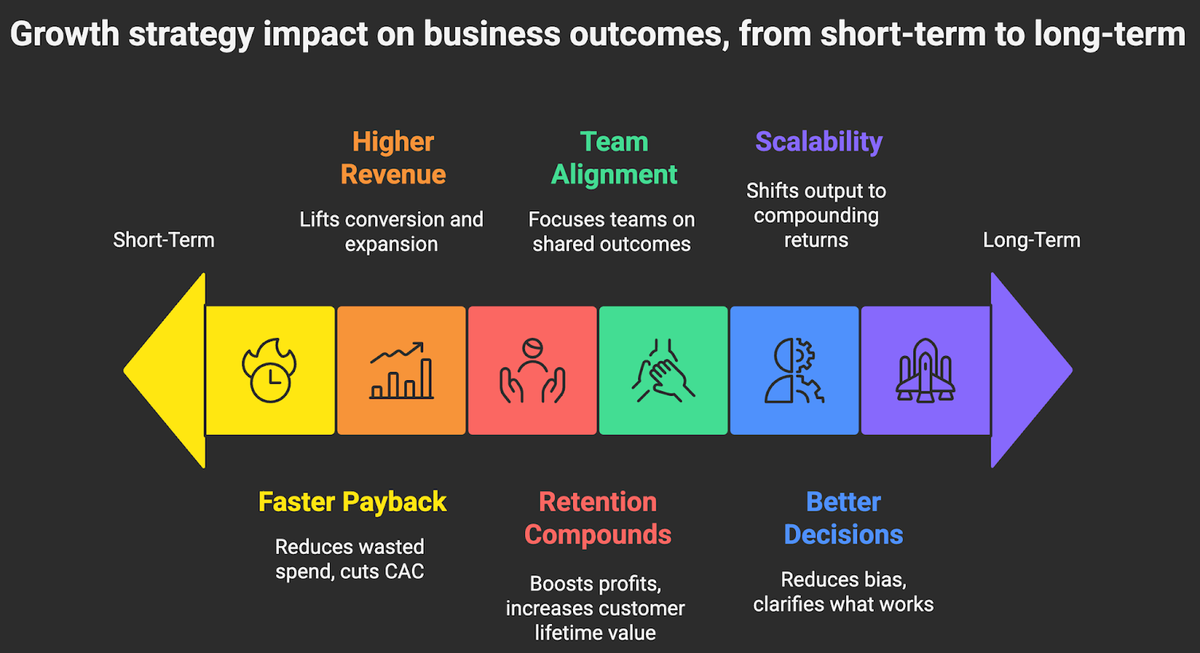
- Faster payback, lower CAC. Experimentation and better audience fit reduce wasted spend, often cutting CAC and payback months meaningfully when combined with lifecycle automation.
- Higher revenue per customer. Personalization and activation improvements lift conversion and expansion. McKinsey reports personalization can deliver 10 to 15 percent revenue lift and 10 to 30 percent marketing spend efficiency gains when executed at scale.
- Retention compounds profit. A 5 percent increase in retention can boost profits 25 to 95 percent, due to lower acquisition pressure and higher customer lifetime value.
- Better decisions with less bias. Structured experiments, pre analysis plans, and unified data reduce HiPPO driven decisions and channel over attribution. MMM and incrementality testing further clarify what truly works.
- Team alignment. One North Star and shared leading indicators focus product, marketing, and sales on the same outcomes, improving operating cadence and accountability.
- Scalability. Growth loops and automation shift output from linear to compounding, so each marginal experiment or feature can produce ongoing returns.
HOW TO DEVELOP A GROWTH MARKETING STRATEGY?
- Define your North Star and guardrail metrics. Choose one metric that best represents customer value delivered, for example weekly active teams, activated subscribers, orders delivered. Add guardrails like CAC, payback, and churn so growth does not erode unit economics.
- Clarify ICP and jobs to be done. Use qualitative interviews and win loss analysis to map core jobs to be done, pains, and triggers. This refines targeting and activation messaging.
- Map the end to end journey. Visualize stages from first touch to referral with conversion rates and time between steps. Identify friction points and high leverage drop offs.
- Instrument events and data flow. Implement reliable event tracking and identity resolution. Typical stack, Segment or mParticle to collect, Snowflake or BigQuery as warehouse, Amplitude or Mixpanel for product analytics, GA4 for web analytics.
- Establish experimentation standards. Create a test charter, hypothesis template, sample size calculators, power thresholds, and a central registry. Use Optimizely, VWO, or Eppo for experiments and LaunchDarkly for feature flags.
- Build your growth model. Quantify the funnel in a spreadsheet or BI tool. Model how changes in activation, conversion, retention, and expansion affect revenue and payback. Use this to prioritize bets by impact and cost.
- Prioritize with RICE. Score initiatives by Reach, Impact, Confidence, and Effort. This tempers loud opinions and focuses the roadmap.
- Design an operating cadence. Weekly growth standup, biweekly experiment reviews, monthly business review against the North Star and financial guardrails. Share learnings in a searchable repo so insights compound.
- Layer in AI and automation. Start where data and scale exist. Examples, predictive lead scoring, automated audience building, creative variation generation, send time optimization, and media mix modeling. Tools include Braze or Iterable for lifecycle AI, Mutiny for website personalization, Meta Robyn or LightMMM for MMM.
- Prove incrementality and compliance. Run geo or user level holdouts on major channels. Adopt consent management and server side tagging to respect privacy while maintaining measurement fidelity.
THE MOST EFFECTIVE GROWTH MARKETING FRAMEWORKS
Framework Use it to Strengths Watchouts AARRR (Pirate Metrics) Diagnose full funnel, set stage level targets Simple, universal, great for baseline and dashboards Linear, can hide compounding loops North Star Metric Align teams on value delivered and leading indicators Clarity, focus, reduces vanity metrics Choose wisely, or teams game the metric Growth Loops Design compounding systems where outputs become inputs Scales non linearly, resilient to channel shifts Requires strong instrumentation, patience Jobs To Be Done Find activation messages, product triggers, and segments Customer grounded, improves activation and retention Needs rigorous discovery to avoid bias RICE Prioritize a growth roadmap objectively Balances reach, impact, confidence, effort Confidence scoring can be subjective
Use multiple frameworks in concert. For example, set a North Star, diagnose with AARRR, design loops, and prioritize with RICE. Then enforce quality with experimentation standards.
MUST-HAVE GROWTH MARKETING TOOLS
Buy for your data gravity and stage. Avoid tool sprawl. A focused stack that your team actually uses always beats a sprawling shelfware collection.
Category Top options Best for Exec tip Customer data platform Segment, mParticle Event collection, identity, audience sync Adopt server side and consent management early Data warehouse Snowflake, BigQuery Unified source of truth across product and GTM Centralize metrics logic in SQL and version control Product and web analytics Amplitude, Mixpanel, GA4 Funnels, cohorts, retention, pathing Define events and properties with a tracking plan Experimentation and flags Optimizely, VWO, Eppo, LaunchDarkly A/B tests, multivariate, feature rollouts Require pre analysis plans to avoid p hacking Lifecycle orchestration Braze, Iterable, HubSpot Multi channel journeys, segmentation, AI send time Own the data model, keep content modular Attribution and MMM Rockerbox, Northbeam, Robyn MMM Multi touch and incrementality, budget allocation Triangulate MTA with MMM and holdouts Reverse ETL Hightouch, Census Sync warehouse segments to ad and CRM Keep PII governance and lineage explicit BI and planning Looker, Tableau, Power BI Executive dashboards, cohort and unit economics Standardize metric definitions company wide Website personalization Mutiny, Optimizely Web ICP specific experiences for conversion Guardrail with holdouts to ensure lift is real
WHAT METRICS MATTER IN GROWTH MARKETING?
Pick a small set that connects to cash flow. Then align teams to move them, with clear formulas and targets.
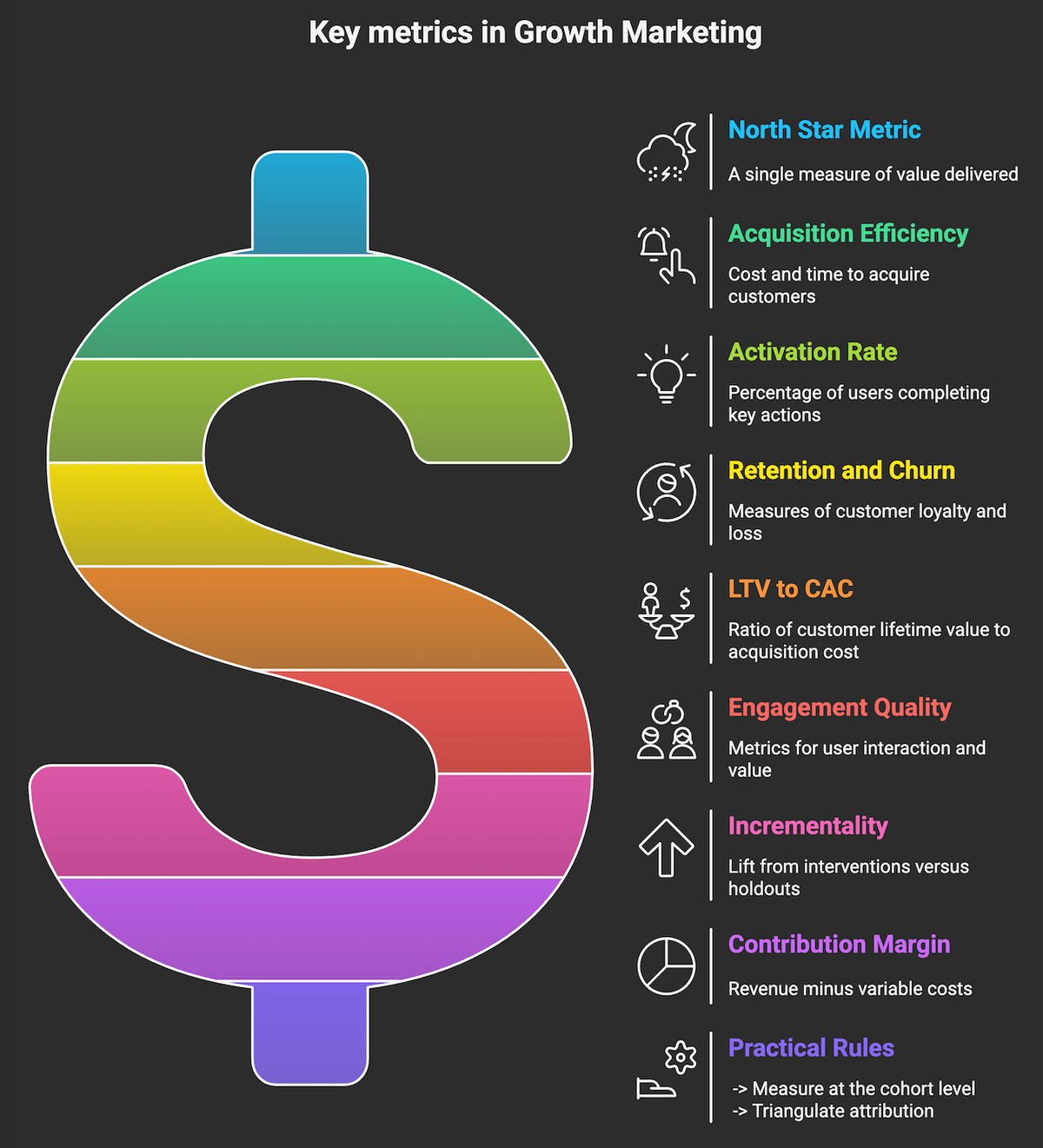
- North Star Metric. One measure of value delivered, for example weekly active teams, orders shipped, qualified signups. Use leading indicators to predict it.
- Acquisition efficiency. CAC, payback period, blended and by channel. Payback under 12 months is a common target for venture backed SaaS, shorter for SMB or bootstrapped models.
- Activation rate. Percent of new users who complete the key action that predicts retention, for example create a project, connect a data source, place first order. Define activation via Jobs To Be Done research.
- Retention and churn. Logo retention, revenue retention, and Net Revenue Retention. NRR over 120 percent is best in class for enterprise SaaS, lower for SMB with higher churn.
- LTV and LTV to CAC. LTV approximates discounted gross profit over the customer lifetime. Many teams use LTV to CAC of 3 or higher as a threshold, with payback checks. See canonical guidance for SaaS economics.
- Engagement quality. DAU to MAU ratio, frequency, breadth of feature usage, time to value. Use cohort charts in Amplitude or Mixpanel.
- Incrementality. Lift from an intervention versus a holdout, expressed as incremental conversions per thousand impressions or incremental revenue per dollar. This guards against over attribution.
- Contribution margin. Revenue minus variable costs, especially important for marketplaces and consumer businesses.
Two practical rules. Measure at the cohort level, not just snapshots, to see durability of improvements. Triangulate attribution, last click, data driven, MMM, and geo or user holdouts, for resilient budget decisions.
TOP GROWTH MARKETING STRATEGIES
- Activation first onboarding. Redesign onboarding around one activation milestone. Use in product checklists, progressive profiling, and contextual guidance. Pair with triggered emails or in app nudges. Expect double digit lifts in week one retention when activation friction drops. Tools, Appcues, Pendo, Braze.
- Lifecycle messaging at scale. Build journeys for welcome, aha, habit building, upgrade, expansion, and reactivation across email, in app, push, and SMS. Use AI for “send time” and tendency targeting to reduce noise and increase relevance.
- Website personalization for ICPs. Serve tailored value props and proof to key segments like industry and company size. Start with high intent pages such as pricing and demos. Guardrail with holdouts to confirm lift is real using tools like Mutiny or Optimizely.
- Referral and invite loops. One click invites in product, visible benefits for both sides, and low friction sharing. Keep the incentive tied to product value to reduce fraud. Design the loop so new users can easily follow it.
- Pricing and packaging experiments. Test value metrics, bundles, and fences. Many organizations under-monetize advanced features. Use simulated choice experiments and limited rollouts before global changes.
- Product led sales. Let high intent users self-serve, then route qualified accounts to sales with product usage signals. Combine PQL scoring with sales plays. Expect shorter cycles and better win rates for accounts with verified usage trails.
- Programmatic SEO and content loops. Structured templates for landing pages, documentation, calculators, or directory pages with schema markup. Ensure quality and uniqueness to avoid thin content penalties. Pair with internal linking and UX polish.
- Paid media with incrementality. Creative and audience testing at scale, with geo or user holdouts and MMM for budget allocation. Train AI bidding with clean conversion signals, server side events, and consented first party data. Tools, Google Ads, Meta, TikTok, Robyn MMM.
- Onsite conversion rate optimization. Heatmaps, session replays, form analytics, and A/B tests on key flows like pricing, signup, checkout. Prioritize the biggest drops and highest traffic pages first.
- Churn interception and save flows. Easy downgrade paths, targeted save offers, and in app success outreach triggered by risk signals. Feed gained knowledge back into the roadmap.
- Revenue expansion. Contextual cross sell, usage based upsell prompts when customers near thresholds, and success led QBRs that focus on realized outcomes, not just features.
- Marketing mix modeling for durable budget decisions. As privacy tightens, triangulate attribution with MMM and controlled experiments to protect ROI during scale.
If you want a second set of eyes on your growth model or stack design, reach out to our team. We help leaders stand up AI driven growth systems that move revenue and unit economics without adding headcount. You can find practical playbooks on blogs posted on our site