Exploring the impact of the Make acquisition by Celonis on 2024's automation examples showcases immense potential.
TRANSFORMING INDUSTRIES
You want real, working examples of automation that reduce cost, increase speed, and improve compliance. This article delivers exactly that. You will get a clear definition of process automation, the concrete benefits, and a deep set of industry examples, from manufacturing to logistics, that you can adapt to your roadmap.
We finish with a practical method to select and automate your first process for measurable ROI, plus where Makeitfuture can help you accelerate with proven playbooks.
WHAT IS PROCESS AUTOMATION?
Process automation is the orchestration of people, systems, and data to execute a repeatable business workflow with minimal human intervention. It uses rules, integrations, and increasingly AI to move work from step to step, enforce policies, and capture an auditable trail. Think beyond a single script or macro. This is end to end flow, from trigger to outcome, across applications and teams.
Industry analysts often refer to the full stack of tools that work together to automate complex processes as hyperautomation, a strategy that combines workflow, RPA, integration, AI, and analytics to achieve scale and resiliency. The point is to automate and continually improve, not just bolt on bots. (Gartner’s glossary explains the concept and why “many tools” is the norm for enterprise scale.)
Here is a quick comparison of common automation approaches and when to use each.
Category Best for Typical tools Time to first value Notes Workflow automation and BPM Structured processes with approvals and SLAs ServiceNow, Microsoft Power Automate, Camunda, SAP Build Process Automation 2 to 8 weeks Model processes, enforce rules, strong audit trail Robotic process automation, RPA Repetitive screen and file tasks without APIs UiPath, Automation Anywhere, Power Automate Desktop 2 to 6 weeks Fast wins, watch for brittle selectors and app changes Integration, iPaaS and events Reliable data sync and system to system flows MuleSoft, Workato, Boomi, Apache Kafka 4 to 12 weeks High reliability, better than bots when APIs exist AI document and voice automation Unstructured inputs like invoices or calls Azure Form Recognizer, AWS Textract, Google Document AI, Nuance DAX 2 to 10 weeks Add human in the loop for accuracy and learning Process and task mining Finding bottlenecks and automation candidates Celonis, UiPath Process Mining, Microsoft Process Advisor 2 to 6 weeks Baseline KPIs and prioritize by business value
WHY DO YOU NEED PROCESS AUTOMATION?
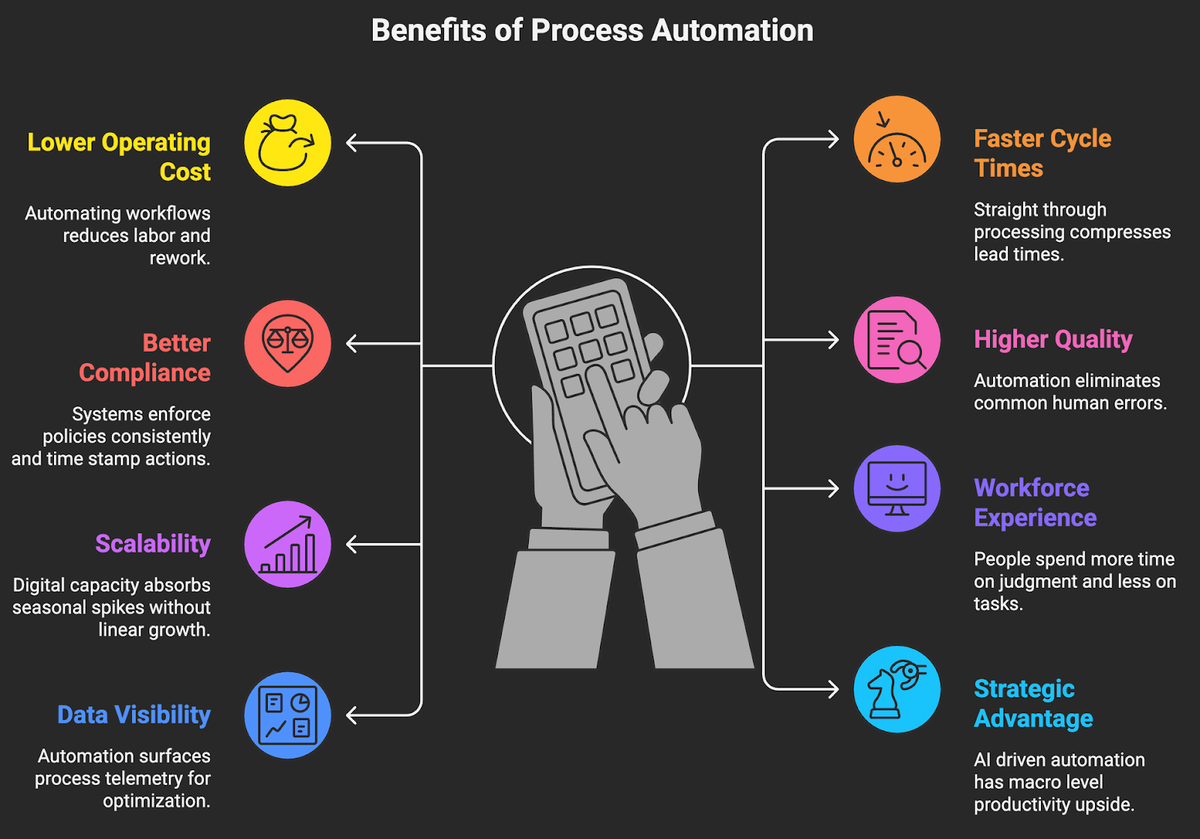
You need to reduce cost, increase speed, and boost quality, all at once. Process automation directly addresses those constraints by removing manual steps, standardizing execution, and exposing performance data you can manage.
- Lower operating cost. Automating high volume workflows like accounts payable reduces labor and rework. Benchmarks show top performers process an invoice for under 2.50 dollars, while laggards spend over 10 dollars, so the cost gap is real and addressable.
- Faster cycle times. Straight through processing, event triggers, and parallel approvals compress lead times, which frees cash, reduces WIP, and improves customer response. Case evidence from TEI studies shows automation often repays in months, not years.
- Better compliance and audit. Systems enforce policies consistently, time stamp every action, and apply segregation of duties. This is crucial for regulated steps such as electronic signatures and records.
- Higher quality and fewer errors. Automation eliminates common human errors like copy paste mistakes or miskeyed data. Computer vision and rules catch defects earlier than manual checks.
- Scalability without linear headcount growth. Seasonal spikes and new product launches can be absorbed by digital capacity, not only new hires.
- Workforce experience. People spend more time on judgment and customer conversations, and less on swivel chair tasks. That helps retention and speed.
- Data visibility for continuous improvement. Automation surfaces process telemetry by default. That supports real time management and ongoing optimization with process mining.
- Strategic advantage. AI driven automation has macro level productivity upside that compounds as you scale. Independent research estimates trillions in potential value across functions and sectors.
INDUSTRY EXAMPLES OF PROCESS AUTOMATION
Below are concrete examples of automation mapped to business outcomes in five industries. Use them as a catalog to inspire your backlog and to challenge vendors with clear acceptance criteria.
MANUFACTURING
Manufacturing leaders automate to boost OEE, stabilize quality, and reduce unplanned downtime. The best programs pair plant floor integrations with enterprise workflows, so decisions flow from sensor to ERP to supplier.
- Automated quality inspection on the line. Computer vision checks surface defects, weld seams, or assembly completeness, then triggers rework tasks. Tools: Azure Cognitive Services, Landing AI, open source libraries with industrial cameras. Expect fewer escapes and better first pass yield.
- Predictive maintenance. Sensor data and equipment telemetry feed models that predict failures, then auto create work orders in EAM. Tools: AWS IoT SiteWise, Azure IoT, PTC ThingWorx, SAP PM. PdM can cut maintenance costs and downtime versus reactive approaches.
- Automated changeover and recipe control. Workflow pushes machine parameters and SOP steps to PLC or MES, with e sign off for compliance. Tools: Rockwell FactoryTalk, Siemens Opcenter, Ignition by Inductive Automation.
- Production scheduling and rescheduling. APS engines optimize sequence based on constraints, then notify supervisors and vendors. Tools: AspenTech, Siemens Opcenter APS, Kinaxis for supply response.
- Supplier ASN and barcode automation. Scan and reconcile inbound against POs, then auto book receipts and variances in ERP. Tools: GS1 compliant barcodes, scanners, SAP or Oracle receiving.
- Safety monitoring. Vision models detect missing PPE or unsafe proximity, then alert and log incidents for EHS workflows. Tools: NVIDIA Metropolis ecosystem, custom CV.
FINANCE
Finance automation targets close speed, working capital, and control. The goal is straight through processing where exceptions get human attention and everything else moves without friction.
- Accounts payable invoice capture and 3 way match. OCR and ML extract headers and line items, RPA or APIs post to ERP, and rules route exceptions. Tools: Azure Form Recognizer, ABBYY, UiPath, SAP Ariba. This directly reduces invoice processing cost.
- Record to report automation. Auto reconciliations, journal entry suggestions, and certification workflows compress the close. Tools: BlackLine, Trintech, Workiva. Expect faster close and stronger controls.
- KYC and AML screening. Automate identity verification, sanctions screening, and case management, with human review for hits. Tools: Refinitiv World Check, ComplyAdvantage, LexisNexis Risk Solutions. Ensure model and policy governance.
- Loan origination and credit decisioning. Prepopulate applications from bank data, score with explainable models, and auto generate disclosures. Tools: FICO Platform, Zest AI, Salesforce Financial Services Cloud.
- Treasury cash positioning. Pull balances and forecasts from banks and ERPs, reconcile variance, and propose sweeps. Tools: Kyriba, Coupa Treasury, custom iPaaS flows.
- Expense policy enforcement. Auto classify and flag out of policy spend, then reimburse straight through. Tools: SAP Concur, Navan, Ramp.
HEALTHCARE
Providers and payers automate to reduce administrative burden, speed care, and prevent leakage. Privacy, safety, and auditability are mandatory, so keep a human in the loop where risk is high.
- Patient intake and EHR data capture. Digitize forms, extract data, and create or update patient records, with e-signature. Tools: Epic and Cerner integrations, Form Recognizer, DocuSign. Reduces clerical load that contributes to clinician burnout.
- Prior authorization. Automate eligibility checks and EDI 278 transactions, then surface payer requirements and status to clinicians. Tools: Availity, X12 EDI, payer APIs where available.
- Claims processing and adjudication. Auto validate claims, detect missing fields, and route denials for correction. Tools: UiPath, Pega, payer core systems. Expect faster cash and lower denial rates.
- Radiology worklist triage. AI flags suspected critical findings and routes studies to the top of the queue, with full audit trails. Tools: FDA cleared solutions like Aidoc integrated with PACS.
- Inventory and supplies automation. PAR level monitoring and automatic reordering for med surg and pharmacy. Tools: Tecsys, Oracle Cloud SCM, RFID.
- Omnichannel scheduling and reminders. Bots book appointments, verify insurance, and send reminders via SMS, reducing no shows. Tools: Twilio, Salesforce Health Cloud, conversational AI.
RETAIL & E-COMMERCE
Retailers automate to improve margins, win the delivery promise, and personalize at scale. The operational backbone is an OMS integrated with forecasting, pricing, and service workflows.
- Demand forecasting and replenishment. ML forecasts by SKU location, then automates order proposals and vendor collaboration. Tools: Blue Yonder, SAS, Amazon Forecast.
- Dynamic pricing and promotion management. Rule based and ML based price updates with guardrails, auto synced across channels. Tools: Revionics, Salesforce Commerce Cloud, Shopify Functions.
- Order management and fulfillment orchestration. Automate order routing, split shipments, and exception handling. Tools: Manhattan OMS, Fluent Commerce, Workato integrations.
- Customer service automation. Bots deflect routine queries, auto process RMAs, and trigger refunds after carrier scans. Tools: Zendesk bots, Intercom Fin, Shopify Flow and Flow extensions.
- Product content enrichment. AI generates listings, attributes, and translations, with human review. Tools: Akeneo PIM, Contentserv, vertex AI for content.
- Fraud detection at checkout. Real time risk scoring blocks high risk transactions while minimizing false positives. Tools: Stripe Radar, Signifyd, Riskified.
LOGISTICS
Logistics operators need reliable, low touch execution from tender to POD. Automation removes keystrokes, improves ETA accuracy, and keeps the dock and yard flowing.
- Dispatch and route optimization. Plan and reoptimize routes with live traffic and constraints, then push instructions to driver apps. Tools: Oracle OTM, Descartes, OptimoRoute.
- Dock and yard scheduling. Self service portal and rules prevent dock conflicts and detention, while sending updates to carriers. Tools: FourKites, project44, bespoke portals with iPaaS.
- Automated customs documentation. Extract and validate commercial invoice data, build entry packets, and submit to brokers. Tools: Descartes, KlearNow, RPA for older portals.
- Warehouse picking and robots. WMS driven pick path optimization and AMRs handle transport, with exceptions escalated to supervisors. Tools: Manhattan WMS, Locus Robotics, 6 River Systems.
- EDI flow automation with 3PLs and shippers. Translate, validate, and acknowledge 204, 214, 210 transactions, then reconcile exceptions. Tools: SPS Commerce, Boomi, MuleSoft.
- Freight audit and pay. Auto match invoices to contracts and audits accessorials before payment. Tools: Trax, Cass, custom rules in iPaaS.
HOW TO AUTOMATE YOUR BUSINESS PROCESS?
Start with one clearly defined workflow and a measurable business outcome. The examples of automation above all work because the objective is specific, the data and systems are known, and success is measured. Identify the process you want to automate, baseline it, and pick the smallest slice that delivers visible value in weeks.
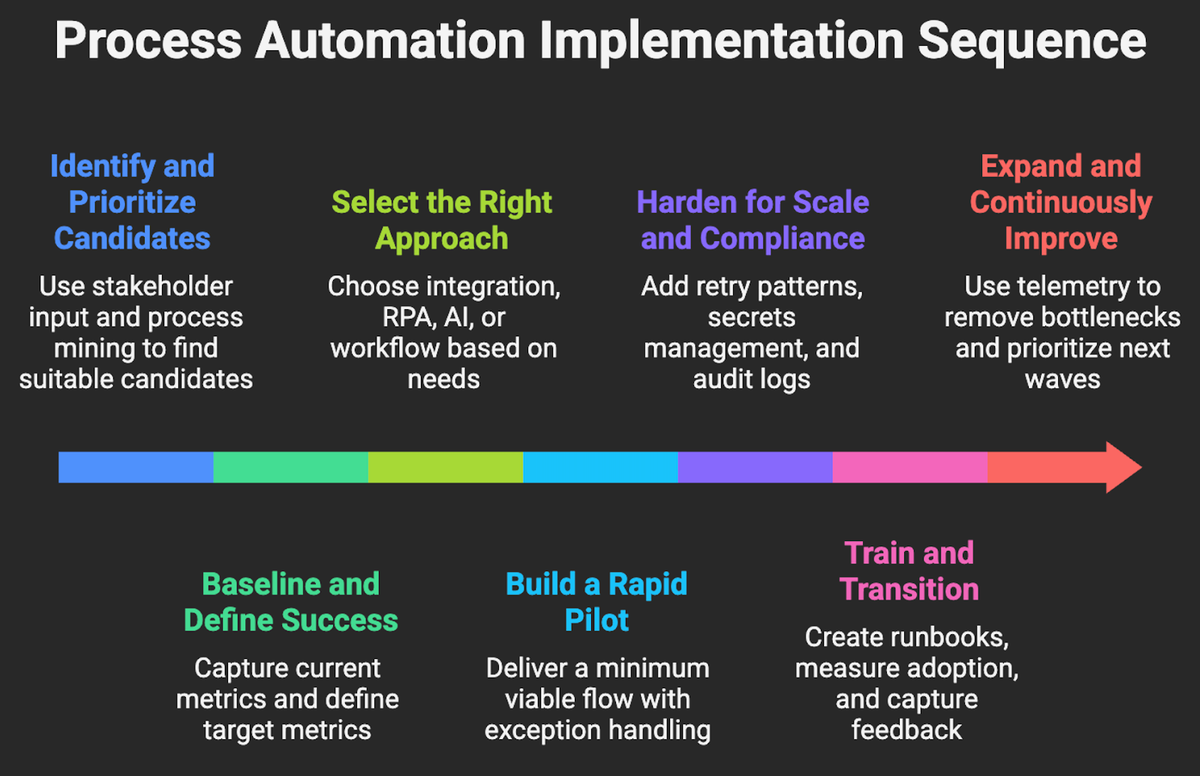
- Identify and prioritize candidates. Use stakeholder input and, where possible, process or task mining to find high volume, rule heavy work with clear pain. Tools: Celonis, Microsoft Process Advisor, UiPath Task Mining.
- Baseline and define success. Capture current cycle time, cost per unit, error rate, and compliance defects. Define target metrics and guardrails for privacy and risk. Consider the NIST AI Risk Management Framework when AI is in scope.
- Select the right approach. If APIs exist, prefer integration. If the app has no API, use RPA. For unstructured inputs, add AI with “human” in the loop. For long running approvals, use workflow.
- Build a rapid pilot. Deliver a minimum viable flow with exception handling and observability. Include test data, rollback, and clear user paths.
- Harden for scale and compliance. Add retry patterns, secrets management, audit logs, access controls, and monitoring. Align with standards such as FDA Part 11 where applicable.
- Train and transition. Create simple runbooks, measure adoption, and capture feedback. Encourage teams to escalate exceptions, not bypass the system.
- Expand and continuously improve. Use telemetry to remove bottlenecks and to prioritize the next wave. Build a lightweight automation Center of Excellence to maintain standards and share components.
Measure time to value in weeks, not months. That focus will drive pragmatic choices and visible wins that build trust.
If you want a partner that brings proven patterns and accelerators, Makeitfuture can help. Make a leap of faith and contact us. We design and implement end to end intelligent automation, from discovery to scale, using enterprise platforms you already own. Explore our automation services to see how we scope, build, and govern automations that your teams love to use.
Prefer to see outcomes first. Browse our selection of case studies, including finance AP automation and ecommerce returns automation, to understand the speed, savings, and control improvements that are realistic in quarter one.